Most factory owners searching for car dash mat cutting machines are not merely looking for ordinary processing equipment. They are stuck in the same production dilemma: how to cut custom car dash mats with complex arcs, precise hole positions and multi-layer composite materials quickly, accurately and cost-effectively.
After cooperating with hundreds of automotive sun shade mat processing factories, we have concluded a clear industry rule. Factories with stable profits and smooth order operation do not rely on more orders, but master the core production rules of dash mat cutting, and abandon outdated processing modes. The following 5 industry truths can help mat manufacturers get rid of "dare not take orders" and realize accurate quotation and stable profit growth.
Truth 1: The Money Saved on Equipment Is Wasted on Labor and Rework
Many small and medium-sized dash mat processing factories still adopt traditional manual processing methods, including manual line drawing, scissors cutting and manual punching. Statistically, 6 workers can only complete 300 sets of dash mats per day on average, which seems to control labor costs to a certain extent. However, the hidden loss behind manual operation is far higher than the equipment investment.
Manual cutting is prone to arc deviation, resulting in warped edges and poor fitting of finished dash mats, directly causing customer returns. Manual punching often leads to offset hole positions, failing to match vehicle installation standards and triggering negative reviews and repeated rework. For multi-layer composite dash mats, manual cutting cannot ensure the alignment of upper and lower materials, resulting in uneven edges and downgraded products. In addition, manual processing quality is unstable, and the cutting precision will decline with staff fatigue, bringing more defective products and waste losses.
All rework, returns, product downgrades and delayed delivery cycles form invisible profit losses. Adopting the CNC oscillating vibration knife cutting machine can completely solve this problem. The equipment supports automatic feeding and continuous rolling processing, and one worker can replace 4-6 manual cutting workers. It not only saves explicit labor costs, but also eliminates hidden losses caused by rework and returns. In most cases, the equipment investment cost can be fully recovered within half a year to one year.
Truth 2: Dash Mat Competitiveness Depends on Edge Finishing, Not Raw Materials
For automotive dash mats and sun shade mats, product fitting accuracy is the primary evaluation standard for customers, and edge flatness and appearance are the secondary core factors that determine product grade and pricing.
Traditional scissors cutting for felt and suede dash mats will cause obvious burrs, wire shedding and zigzag edges, making the products look low-grade and unable to meet the requirements of medium and high-end markets. Although laser cutting features high precision, it relies on high-temperature thermal cutting. The high-temperature burning will scorch the edges of dash mats, resulting in black and hard edges, and produce pungent peculiar smell that cannot be dissipated for a long time after vehicle installation, seriously affecting product quality and user experience.
Different from traditional processing methods, the oscillating knife cutting machine adopts high-frequency vibration blade physical cold cutting technology without high-temperature heating. It perfectly adapts to common dash mat materials such as felt, suede, chemical fiber and silicone composite cloth. The cutting edges are flat, soft and consistent in color, without thermal damage, scorch marks, peculiar smell, wire shedding and burrs. The finished products are consistent with the original material hand feel, fully meeting the quality standards of domestic high-end orders and export orders.
Truth 3: Fast Template Switching Determines Order Bearing Capacity
The biggest processing pain point of custom car dash mats is the diversity and complexity of vehicle models. The product styles are updated rapidly, with dozens of different vehicle model specifications needing processing every day. Traditional manual line drawing and proofing have extremely low switching efficiency. Skilled workers can only switch 3-5 templates a day, and complex arc patterns require repeated modification and correction, seriously restricting the factory's order receiving capacity.
The intelligent vibration knife cutting machine completely breaks the limitations of manual processing. It requires no manual line drawing or custom cutting molds. Operators only need to import the CAD template files of different vehicle models into the system, and the equipment can automatically complete curved cutting, hole opening, gap cutting and edge wrapping forming at one time. The processing precision is stably controlled within ±0.1mm.
Template switching only takes a few minutes by replacing files. The equipment can cope with the processing of more than 30 vehicle model styles per day efficiently, enabling factories to easily receive multi-variety and small-batch customized orders and greatly expand market share.
Truth 4: Material Waste Comes From Backward Typesetting, Not Manual Operation Errors
Common dash mat raw materials such as suede, felt and silicone anti-slip cloth are high-cost industrial auxiliary materials, and every inch of material loss will directly compress product profits. Traditional manual typesetting relies on worker experience and visual estimation, with no scientific material layout scheme. The comprehensive material loss rate of manual processing is as high as more than 15%, and a large number of leftover materials cannot be reasonably utilized, resulting in serious profit waste.
Equipped with an intelligent automatic nesting system, the oscillating knife cutting machine can intelligently identify different product templates and calculate the optimal nesting scheme in seconds. It makes full use of leftover materials and blank areas, effectively improving material utilization rate by 10%-20%. For factories with large monthly material consumption, the saved material cost is considerable pure profit, which greatly improves the overall profit margin of dash mat products.
Truth 5: Equipment Is Productivity, Not Unnecessary Expense
Many factory owners are hesitant to introduce automated cutting equipment, worrying that unstable order volume will lead to equipment idling. In fact, fluctuating orders are the core reason for configuring intelligent cutting equipment.
In peak order seasons, the oscillating knife cutting machine supports 24-hour uninterrupted continuous operation, eliminating the trouble of temporary recruitment and labor shortage. In off-seasons, a single worker can operate multiple devices independently, minimizing labor costs. For multi-variety, small-batch and customized orders, the equipment realizes rapid template switching and flexible production, allowing factories to take all kinds of customized orders without hesitation.
With automatic rolling feeding function, high-precision cold cutting technology and intelligent material-saving typesetting system, the equipment replaces 4-6 manual workers. It is not a simple cutting device, but a set of standardized, replicable and efficient production system, helping factories achieve stable production and profit growth.
Applicable Dash Mat Types for Oscillating Knife Cutting Machine
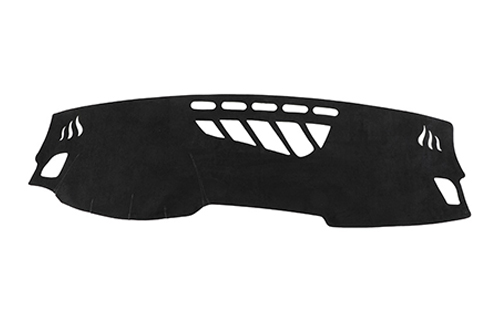
1. Automotive instrument panel dash mats: custom vehicle-specific models, universal models, suede models, felt models, silicone anti-slip bottom models;
2. HUD head-up display dash mats: suitable for high-precision hole position cutting requirements;
3. Household shading mats and equipment dash mats: support special-shaped cutting and multi-layer composite material processing for small-batch customization;
4. Export-grade dash mat orders: meet environmental processing standards with no scorch marks, no peculiar smell and no thermal damage.
FAQ About Dash Mat Cutting Machine
Q1: Will felt and suede dash mats produce burrs and wire shedding after cutting?
A1: No. The physical cold cutting mode ensures flat and smooth cutting edges without burrs, wire shedding and thermal deformation, requiring no secondary trimming.
Q2: Is the hole position cutting accurate?
A2: The outline and hole positions are formed in one time with a stable precision of ±0.1mm, ensuring zero error in vehicle installation and perfect fitting.
Q3: Does the machine support automatic feeding for rolling materials?
A3: Yes. It supports automatic feeding, cutting and material collection of full rolling materials, realizing unattended continuous production with only one worker on duty.
Q4: Is template switching complicated?
A4: Super simple. Just import CAD design files to complete template switching in a few minutes, with no need for manual line drawing or custom molds.