PP film features thin thickness and seemingly easy processing, but it is stretchable, heat-sensitive and demanding in cutting precision. Improper equipment and processing technology will generate huge hidden costs in actual production. This article comprehensively analyzes the shortcomings of mainstream PP film cutting methods and introduces the mature and optimized solution of
CNC oscillating vibration knife cutting machine accumulated over 16 years, helping manufacturers solve all core cutting pain points fundamentally.
Four Mainstream PP Film Cutting Methods & Their Unavoidable Defects
Currently, industrial PP film processing mainly adopts four cutting technologies: manual cutting, laser cutting, die stamping and rotary disc knife cutting. None of the traditional methods can balance quality, cost, efficiency and flexibility, restricting the market competitiveness of processing enterprises.
1. Manual Cutting: Rising Labor Cost, Low Efficiency & Poor Precision
Manual cutting is the most common processing method for small and medium-sized PP film factories, using utility knives, straightedges and scissors for blanking. Its drawbacks are extremely prominent in modern mass production. Factories need to equip 4-6 workers for a single blanking line, and labor costs keep rising year by year with increasing difficulties in recruitment and employee retention. New workers require long training and have high error rates, while peak-season order delivery relies on overtime work with limited production capacity.
Due to the strong ductility of PP film, uneven stretching and laying force during manual operation easily cause material deformation, resulting in dimensional errors of several millimeters, skewed edges and inconsistent product sizes. It is almost impossible to cut standard round, perforated and special-shaped blanks, leading to high rework and scrap rates. In addition, manual typesetting depends entirely on worker experience with low material utilization. For high-value food-grade and optical-grade PP films, excessive waste causes continuous profit loss. Meanwhile, uneven manual cutting force leads to burrs, wire drawing and warped edges, resulting in unstable batch quality and failure to undertake high-end orders.
2. Laser Cutting: Thermal Damage to Materials, Environmental & Quality Risks
Many manufacturers choose laser cutting for special-shaped processing, but it is not suitable for PP film production due to inherent thermal cutting characteristics. Laser cutting adopts high-temperature thermal melting, which causes instant melting of PP film edges, resulting in sticky edges, whitening, hardening and shrinkage holes. These defects completely damage the transparency and surface texture of the film, failing to meet the quality standards of food packaging films and electronic protective films with strict appearance and performance requirements.
High-temperature burning of PP film produces volatile flue gas, requiring supporting large-scale waste gas treatment equipment to pass environmental inspections. Moreover, the thermally melted edges cannot meet the production specifications of food-contact PP films. For thickened PP sheets, laser cutting easily causes section carbonization and back surface slag residue, increasing subsequent cleaning costs and reducing product yield.
3. Die Stamping: Obvious Press Marks, High Mold Cost & Poor Flexibility
Die stamping is only applicable to single-specification mass production and cannot adapt to the current diversified and customized order mode. High-pressure stamping easily causes indentation, folds and flatness damage on thin PP films, and multi-layer stamping often leads to interlayer displacement with poor dimensional consistency.
Each special-shaped blank requires a customized professional die, resulting in high cumulative mold costs for multi-style orders. New product proofing takes 3-7 days for die opening, failing to match fast-order delivery cycles. For small-batch customized orders, the average die cost per product is too high to generate profits, forcing manufacturers to abandon high-value customized orders.
4. Rotary Disc Knife Cutting: Single Function & Severe Limitations
The rotary disc knife features fast straight-line slitting speed but extremely single functions. It can only complete simple linear cutting and cannot process round corners, arcs, hollow holes and irregular special-shaped contours, seriously limiting product categories and customized order undertaking capacity.
The processing principle of rotary knife cutting is material extrusion and tearing. PP film is prone to indentation and rebound after stress, resulting in dimensional deviation, edge burrs and curling. Secondary manual trimming is required after cutting, increasing labor procedures and production costs.
16-Year Technical Precipitation: Fully Automatic PP Film Vibration Knife Cutting Solution
With 16 years of professional manufacturing experience in flexible material cutting equipment, we have optimized the whole processing technology of coil feeding, multi-layer stacking cutting and intelligent typesetting targeting the characteristics of PP film (thin and stretchable, heat-sensitive, multi-style and small-batch orders). The
digital flatbed vibration knife cutting machine is not a modified general-purpose device but a mature professional solution tailored for PP film processing scenarios, solving all traditional cutting pain points in one stop.
1. Automatic Coil Feeding + Multi-Layer Stacking Cutting, Saving 4-6 Labors
The equipment supports direct loading of full-volume PP films, equipped with automatic unwinding, deviation correction and continuous feeding systems. It eliminates manual film laying, alignment and fixing procedures, saving 2-3 workers in the feeding process alone. The stable vacuum adsorption platform fixes materials tightly to avoid stretching and displacement.
Thin PP films support multi-layer overlapping cutting, doubling production capacity with one-time cutting. A single vibration knife cutting machine can replace the daily output of 4-6 skilled workers. It greatly cuts annual labor costs, recovers equipment investment within half a year to one year, and realizes stable and controllable production capacity without being affected by personnel turnover.
2. Physical Cold Cutting with No Thermal Damage, Qualified Edge Quality at One Time
Different from thermal cutting technology, the
CNC oscillating vibration knife cutter adopts high-frequency vibration blade physical cold cutting at normal temperature. There is no high-temperature melting, smoke or smudging during the whole process, fundamentally solving the problems of sticky edges, whitening and hardening in laser cutting.
The cut PP film edges are smooth, burr-free, non-curling and non-drawing, completely retaining the original transparency, surface texture and physical properties of the material. It meets the high-standard quality requirements of food-grade packaging films, electronic protective films and high-end printing films without secondary trimming, optimizing subsequent processing procedures and improving product grade and order premium.
3. CNC Mold-Free Special-Shaped Cutting, Flexible for All Order Sizes
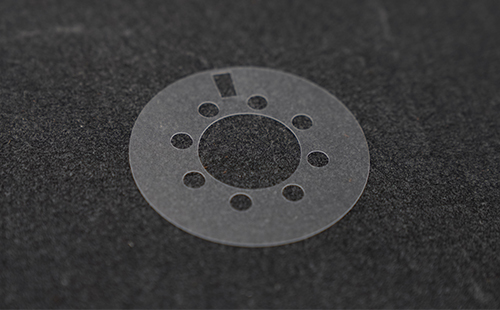
The equipment is compatible with mainstream design file formats such as DXF, CAD and PLT. It only needs to import electronic drawings to generate cutting paths automatically, realizing one-time precise forming of conventional sheets, round corners, arcs, hollow holes and irregular special-shaped parts without any die opening.
New product proofing can be completed on the same day, enabling instant undertaking of small-batch customized orders. Style adjustment only requires modifying electronic drawings, with production switching completed in minutes. It perfectly adapts to the modern processing mode of multi-style, small-batch and fast-delivery orders, helping manufacturers capture more high-value customized orders.
4. Intelligent Automatic Typesetting, Improving Material Utilization by Over 10%
Built-in professional intelligent nesting software automatically identifies blank shapes, optimizes layout paths, and supports common-edge cutting and compact nesting to maximize the utilization of residual material gaps. Compared with manual empirical typesetting, the material utilization rate is increased by more than 10%.
For high-unit-price food-grade and optical-grade PP films, long-term intelligent material saving greatly reduces raw material costs and directly improves order net profit, bringing stable and considerable economic benefits for mass production factories.
5. Servo CNC High-Precision Cutting, Zero Batch Dimensional Error
Equipped with industrial-grade servo CNC control system, the cutting precision is stably controlled within ±0.1mm. The tool path runs stably without jitter, accurately restoring complex structures such as arcs, sharp corners and small hole positions. The high-power vacuum adsorption platform firmly fixes PP films to avoid stretching and displacement during processing.
All blanks in batch production maintain consistent dimensions, thoroughly solving the problems of inaccurate manual cutting sizes, high rework rate and unstable batch quality. It effectively reduces customer complaints and product return rates, improving factory order delivery credibility and market competitiveness.
Full-Category PP Film Adaptation & Multi-Industry Application Scenarios
The professional vibration knife cutting equipment is suitable for all types of PP film materials, including transparent PP film, matte PP film, food-grade PP packaging film, electronic protective film, printed composite PP film, release PP film, flame-retardant PP film and thickened PP sheets.
It is widely applied in food packaging film cutting, electronic protective film slicing, printing film special-shaped die cutting, plastic bag blanking, industrial protective film processing, release film precision cutting and packaging lining sheet processing, covering most flexible film processing scenarios in downstream industries.
16-Year Factory Guaranteed Service for Stable Production
As a professional flexible material cutting equipment manufacturer with 16 years of production experience, we provide one-stop full-cycle service support instead of single equipment sales to help customers launch production quickly with zero trial and error.
Free sample cutting service is available. Customers can send PP film materials for free machine cutting tests, with actual effect videos and finished samples provided for confirmation before cooperation. After equipment arrival, professional technicians provide on-site installation, commissioning and one-on-one operation training, enabling novice operators to work independently within 3 days.
The equipment is built with a mature parameter library for full-category PP film processing, eliminating repeated debugging and trial and error. Free lifelong software upgrades and remote parameter optimization services are provided for new materials and new processes. Nationwide after-sales outlets realize rapid remote troubleshooting and on-site hardware maintenance, ensuring continuous and stable operation of production lines even in peak order seasons.
PP film cutting is a core process that directly determines factory labor cost, material loss, product quality and delivery capacity. Traditional manual, laser, die stamping and rotary knife cutting methods have obvious bottlenecks in cost, quality and flexibility, which can no longer adapt to the increasingly fierce market competition.
If you are troubled by high labor cost, low efficiency, poor precision, excessive waste and unstable quality in PP film processing, feel free to contact us. We provide free sample cutting tests, exclusive customized cutting solutions and accurate equipment quotations to help you calculate input-output benefits and select the most cost-effective film cutting equipment for your factory.